The scientific manager used this device in accordance with Sponsorship Guidelines (https://tdl-solutions.com )
Summary Methodology
The first step of the MicrotoxO protocol consists of cultivating the selected bacterial strains (Escherichia coli and Lactobacillus plantarum) in specific nutrient growth media.
The second step is first, from a concentrated solution of cultured bacteria, dilute them in a diluent specified below for ultimately get a concentration of several tens of thousands of bacteria per milliliter (cfu / ml): (The second step is to dilute the concentrated cultured bacteria solution down to a concentration of several tens of thousands of bacteria per milliliter (cfu/ ml).
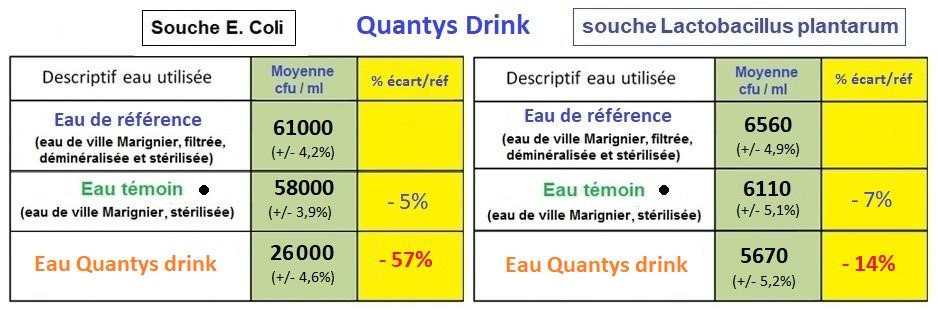
If the diluent is peptone water, (Peptone water is a microbial growth medium composed of peptic digest of animal tissue and sodium chloride. Peptone water is also a non-selective broth medium which can be used as a primary enrichment medium for the growth of bacteria.) it is the reference or the white (in bacterial concentration) coming from the water of the town of Marignier, filtered by activated carbon, demineralized with resins and sterilized.
If the diluent is Marignier city water, sterilized or not. This water is used as a control to test the “Quantys Drink” device.
Then, the bacterial seeding is carried out for all the batches by the spiral method on a culture agar. Each lot is tested in three copies (triplicate) whose average is included in the results.
The bacterial developments of the four batches after 48 hours of parboiling at 44 ° C, that is the number of Colonies Forming Unit per milliliter (cfu / ml).
Results
MicrotoxO test data on the influence of the device “Quantys drink” on a pathogenic bacterial strain of E. Coli indicate a net inhibitory effect of growth of -57% compared to the control water.
Data on Lactobacillus plantarum indicate an inhibitory effect significant growth of – 14% compared to the control water.
Assessment and Interpretation
The data analysis shows that the “Quantys drink” device possesses a net inhibiting power on the growth of a strain of microbiotic bacteria “pathogenic”; Escherichia Coli and a significant inhibitory effect on Lactobacillus plantarum (bacterium biogenic ie useful) compared to a control water (city water sterilized).
In view of these findings, it appears that a drinking water modified by the the “Quantys drink” device can be consumed regularly because it participates in the balance of the gut microbiota by affecting moderately useful flora, called biogenic.
Limits of Validity of the MicrotoxO test
The present methodological conditions of the MicrotoxO test do not allow for know the effect on other bacterial species, especially flora symbiotic. (The present methodological conditions of the MicrotoxO test do not yet evidence the effects on other bacterial species, especially symbiotic flora.)
New tests on other pathogenic microbiotic strains and biogens would be needed to accurately determine the inhibitory effects of the “Quantys drink” device and its possible persistence of action in the time. (New tests on other pathogenic and biogenic microbiotic strains are needed to accurately determine the inhibitory effects that the Quantys Drink has and how long the inhibitory action persists.)
It should also be noted that the present conditions for implementing the test do not may prejudge the effect of the observed effect on a bacterial concentration higher. The bacterial concentration chosen in experiments on E. Coli and Lactobacillus plantarum, corresponds to that which can modify a state Ecological instability towards an unbalanced or even pathological state.
Moreover, notwithstanding the inhibitory or non-inhibitory effects on the growth of two types of bacteria used for the MicrotoxO test, it should be emphasized with insistence that the microbiotic profile of a person is singular and multifactorial.
Indeed, it depends on all the components of our lifestyle and their interactions, including the quality of the water consumed and the food mode that interfere in a complex way on our microbial intestinal balance.
Let us say that the scientific team in charge of analyzing the data of various experiments of the MicrotoxO test gives free rein to the sponsor of the study and disclaims any responsibility in its recommendations for use for users, particularly as a regular imbibition, waters subject to device or of it.
This responsibility of the Sponsor is consistent with intellectual property rights stipulated in the research contract. It suits to clarify that the MicrotoxO test is of a microbiological nature and therefore indicates the possible impact on potability of the criteria physical and chemical standards (D1 or D2 by French standards) for the analysis of drinking water.